
°°°°~x§x-<@>
Frank, Gleiser and Thompson (2024) showed that modern science has a blind spot: it can see everything except what makes vision possible. The report From AGI to ASI just published by Google DeepMind (June 2026, arXiv) is a textbook case. Sixty pages of brilliant foresight on the paths toward superintelligence. And yet, closing the document, one question remains: what about the observer?
The report is a tour de force. Tim Genewein, Shane Legg and their team map out with rare honesty the possible trajectories of artificial intelligence beyond the human level. They define AGI (a system equivalent to a median human), ASI (a system surpassing entire collectives of experts), and leave AIXI as the theoretical bound. They identify four paths — scaling, paradigm shifts, recursive self-improvement, multi-agent coordination — and six frictions that could slow them down, from the data wall to political regulation.
The tone is measured, uncertainty is made explicit, assumptions are discussed. For anyone following the AI debate, this is a reference synthesis.
It is precisely for this reason that it must be read carefully — and with a gaze the report, by construction, cannot bring to bear.
1. A Foresight That Observes Itself
First critical gesture: the report is produced by DeepMind, one of the dominant actors in the AGI race. This is not peripheral information — it is a structuring variable of the document.
Its gesture is twofold. On one hand, it is contributive: mapping uncertainty to inform research and public policy is a real service. On the other hand, it is positional: by publishing this analytical framework, DeepMind positions itself as the legitimate authority to define what ASI is, which paths lead there, how to measure progress. The report does not say this, but it is also an act of epistemic power — fixing the terms of the debate already orients the answers.
Concrete consequence: the effective compute growth rate (10x/year, extrapolating past trends) is presented as a neutral observation. But this rate is not a natural fact. It is the product of investment decisions made by the same actors publishing the report. By publishing it, DeepMind does not describe a trajectory — it reinforces it. The report becomes a self-fulfilling prophecy: the more it is cited, discussed, and used to justify investment strategies, the more its projected trajectory materialises. It provides a quantified justification to funders, partners, regulators: “progress is at this pace, you must keep up.” The line between description and prescription blurs. The report is an act within the dynamics it claims to observe.
Furthermore, the report treats governance and regulation as an “external friction” — a possible brake on technical progress. It never considers that technological dynamics and political dynamics might be structurally coupled, that regulation is not an exogenous variable but a component of the system. You can read fifty pages without encountering the question: who controls the compute infrastructure, who sets safety standards, how do power asymmetries structure the possible trajectories.
2. The Abstraction Barrier Touches Something Fundamental
Among the six identified frictions, one stands out for its unexpected depth: the “abstraction barrier” (formulated by Alexander Lerchner, co-author of the report). The hypothesis is this: current AI systems are trained on human cognitive products (texts, images, code). They inherit our concepts, our categories, our ways of carving the world. But can they discover new ones? Can they invent conceptual primitives that humans have never articulated?
The report’s answer is cautious. It gives a telling example: what would a model trained on all pre-industrial knowledge produce, without access to Newton, Darwin or Einstein? Could it reconstruct general relativity or quantum mechanics? The authors’ intuition is that it could not — that the model would remain trapped within the conceptual frameworks of its training corpus. To truly discover new concepts, some form of integration into a robotic body would be needed, an interaction with the physical world that allows hypotheses to be validated or invalidated.
This observation is remarkable. It almost names what enaction calls operational closure, and what scybernetics develops in its wake: a cognitive system cannot question the structures through which it is coupled to its environment from within its own functioning. It can explore the space defined by those structures, but it cannot change the rules of the game without a perturbation from the outside — or an internal reorganization over which it has no explicit control.
The authors frame this as a technical bottleneck to be solved (more robotic integration, more interaction-based learning). But it may be a fundamental property of cognitive systems — a constraint that even the most powerful ASI could not lift without changing its nature. The report does not draw this consequence.
3. Four Paths, Four Regimes of Coupling
If one re-reads the four paths toward ASI with this intuition, another landscape appears. Scaling (more compute, more data, more models) is not a path toward a different kind of intelligence: it is the intensification of the same coupling regime. The system sees better, faster, farther — but under the same modalities. This is an increase in sensitivity without a change in structure.
A paradigm shift, on the other hand, would be a structural bifurcation: a reorganization of the system’s operating rules. But the report itself notes that such bifurcations are unpredictable by nature. It cannot model them, only hope for them.
Recursive self-improvement is perhaps the most fascinating path. The system produces the conditions for its own improved reproduction. It is a form of technical autopoiesis — a loop where the system fabricates the means to refabricate itself. In a scybernethics reading, this loop nevertheless remains coupled to an environment that constrains it: experiments take time, resources are limited, physical laws do not negotiate.
The multi-agent path, finally, suggests that ASI could emerge from the coordination of many systems, none of which is super-intelligent individually. This is a shift to a higher level of observation, where intelligence is no longer an individual property but a relational one. The report considers this possibility, but frames it in terms of optimization and efficiency, not in terms of organizational emergence.
The question the report never asks: are these regimes in permanent co-determination? A system that scales also undergoes internal bifurcations; a system that self-improves changes the conditions of its own coupling. The four paths are not mutually exclusive — but the analytical framework does not allow thinking their interaction.
4. What the Report Does Not See
The DeepMind report is a remarkable document. It will be cited, discussed, used as a reference. And that is precisely why we must point out what it cannot see from its position.
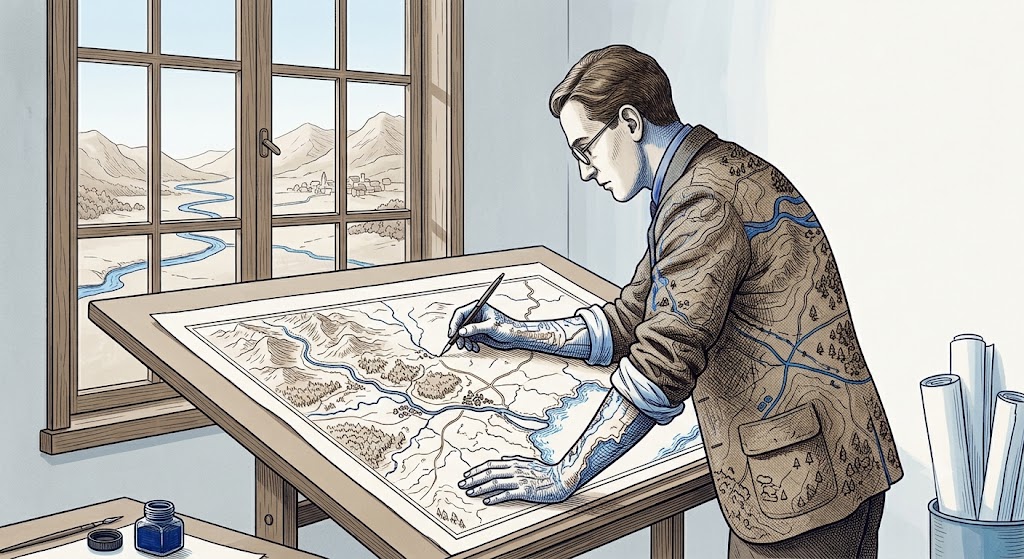
The observer is inside the system. The report describes a field (the AI research ecosystem) from the position of an external observer. But DeepMind is not external. The growth rates, the scenarios, the identified frictions — all of this is part of the system it describes. Publishing this report already modifies the field. The map is never neutral when the cartographer is inside the territory.
ASI is not a degree but a regime. The report posits an AGI→ASI continuum via the Legg-Hutter score. This modeling naturalizes the idea that ASI is more of the same: more compute, more data, more intelligence. But it is possible that the transition is not an additional degree on a continuous scale, but a change of regime — a reorganization of what it means to “be intelligent” that is not captured by an optimization metric.
Second-order rationality. The report describes systems becoming more intelligent in the classical sense: they solve problems better, predict more accurately, optimize more efficiently. It never considers systems that become aware of their own observation — systems capable of interrogating their own conditions of resolution. Or perhaps this discontinuity is already here, and we simply call it… the living.
The DeepMind report is a marvel of technical foresight. Its value is immense. But its blind spot — the mission it sets itself and the blind angle it produces — is as instructive as what it reveals. It maps ASI with unprecedented precision, but it cannot see that it is already an actor.
The open question, for us, is not “when ASI?” It is: “what kind of intelligence do we want to see emerge — and at what decision table will this question be asked?”
The report is freely available: arxiv.org/pdf/2606.12683
°°°°~x§x-<@>