
°°°°~x§x-<@>
(Elaborated with the help of a LLM)

Introduction
The concept of invention is traditionally interpreted as the act of bringing forth something new—be it a tool, theory, system, or paradigm. However, within the deep waters of contemporary philosophy of individuation, and especially through the lens of Gilbert Simondon, invention is recast as a process of mutual transformation: a novel mode of compatibility arises between an organism and its milieu, while a harmonious integration is achieved among the “subsets of the action” within the organism itself. For Simondon, the act of invention modifies not only the world but also the inventor—sometimes most profoundly so.
From this vantage point, the theoretical and lived project of “Scybernethics” appears as a compelling instantiation of invention as individuation. Scybernethics cannot be reduced to a codified method or doctrine; it is simultaneously the product of, the medium for, and the ongoing narrative of a self-inventing subject. This article aims to show, through a rigorous conceptual examination supported by first-person reflection, how Scybernethics is best understood as the invention of myself—the author—in the strong Simondonian-enactive sense. Drawing upon philosophical, cybernetic, hermeneutic, and cognitive scientific sources, we will trace the emergence of Scybernethics as a living and evolving individuation process.
Chapter 1: Theoretical Foundations—Simondon’s Individuation and Enactive Epistemology
1.1 Simondon: Invention as Individuation
Gilbert Simondon’s philosophy of individuation (Simondon, 2022) is a persistent inquiry into how beings come to be—not as fixed entities, but as ongoing processes. Individuation, for Simondon, is the genesis of the individual as a singular, metastable entity arising from a preindividual field of tensions and potentials. Crucially, Simondon’s analysis of invention frames it as:
“the emergence of an extrinsic compatibility between the milieu and the organism and of an intrinsic compatibility between the subsets of the action” (Simondon, 2022: 139).
Here, invention is inseparable from individuation: it is not simply a novel output, but a dynamic achievement in which both the inventor and their context (milieu) are transformed, stabilized, and made newly coherent. This view strongly contests the static, atomistic view of agency and creativity. Instead, the inventor is reintegrated within the complex-field of their own invention—a processual outcome.
1.2 Enaction: Structural Coupling and First-Person Transformation
Enaction theory (Varela, Thompson & Rosch, 1993) similarly shifts perspective from the static observer to the lived dynamism of sense-making and autopoiesis. The crux of enactive epistemology is structural coupling: the organism and environment co-determine one another through sustained, recursive interactions. Cognition is not computation sobre pre-given contents, but the “bringing forth of a world” through embodied activity and first-person agency.
As Varela suggests, “a mutation of experience (that is, of being) is as necessary as a change in intellectual understanding, if one wants to achieve suture the dualisms of mind and body” (Varela, 1976, cited in Bitbol, 2006). The epistemic subject, in enaction, is always already becoming; the act of knowing is inseparable from the transformation of the knower.
Chapter 2: Autobiographical Genesis—Scybernethics as an Enacted Invention
2.1 Contexts, Catalysts, and the Epistemic Dilemma
The genesis of Scybernethics is rooted in the conscious grappling with epistemic, phenomenological, and technological dilemmas—how does one reconcile first- and third-person perspectives, bodily and conceptual knowledge, the “blind spots” of scientific objectivity, and the creative/transformative dimension of lived experience?
Beginning with a background in biology and cognitive science, I found myself unsatisfied with reductionist accounts of knowledge, selfhood, and creativity. The tradition of cybernetics, second-order systems, and enactive science offered a horizon: what if rationality itself could become reflexive, heuristic, and creative? What if the observer could be scientifically and existentially resituated at the heart of their own sense-making?
2.2 Method: Reflexive Iteration, Heuristic Cycles, and Memorial Self-Writing
Scybernethics did not arise all at once. Rather, it emerged through a complex game of dialogical cycles: engaging with existing theories, designing and simulating models, reflecting upon experience, and returning—transformed each time—to the initial questions. The process became not only intellectual, but affective and existential, as lived sense-making demanded the integration of conceptual dipoles (object/subject, self/other, action/reflection).
A key tool in this individuation was the creation of a memorial technics (hypomnemata, in the sense of Foucault and Stiegler): disciplined and self-reflexive writing, diagramming, and simulated modeling, functioning as interfaces for recollecting, testing, and re-inventing myself across iterations.
2.3 A Theory Lived, A Life Theorized
Unlike classical theories that externalize their objects, Scybernethics was lived as an enacted theory—one where theory and life, self and world, mutually co-constituted each other. Each new conceptual insight, each cycled heuristic, produced not just a more sophisticated method, but a modified subjectivity—one able to “hold” the complexity of distributed, dialogical, non-foundational sense-making.
The boundaries between “inventor” and “invention,” “theorist” and “theory,” became increasingly porous. This is not solipsism but the iterated discovery that every creative act is at once a gesture of world-formation and self-formation.
Chapter 3: Pattern Parallels—Scybernethics and Simondonian Invention
3.1 Extrinsic Compatibility: Structural Coupling with the Milieu
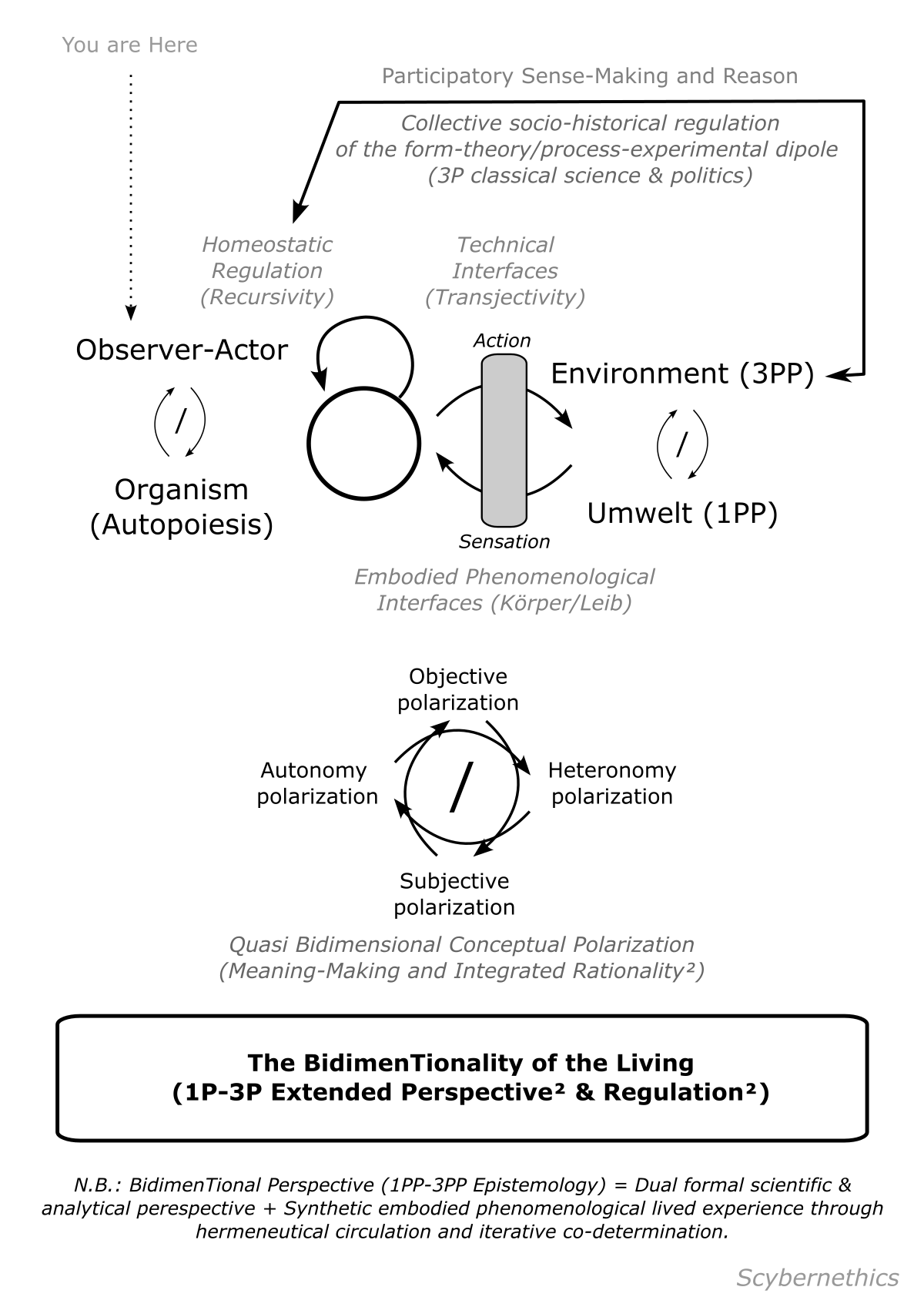
Through Scybernethics, the self is constantly negotiating its relation to its environment—both epistemic (the disciplinary fields, conceptual challenges, available technologies) and lived (cultural, social, and affective embeddedness). The invention is not fixed, but dynamically configured through a process of “structural coupling” (Varela) or “rapport” (Simondon).
Scybernethics instructs the subject to become actively responsive: to see the milieu not as a backdrop, but as a co-determining partner in one’s own individuation. This is explicitly reflected in methodological design, tool selection, and even ethical inquiry.
3.2 Intrinsic Compatibility: Harmonizing Subsets of Action
Internally, Scybernethics “invents” the generation of coherence across the manifold actions of the self: cognitive, emotional, technological, social. Reflexive cycles ensure neither collapse into undisciplined relativism nor sterile abstraction. Instead, a living dialogue is established—between intuition and logic, sensation and abstraction, technological simulation and lived phenomenology.
3.3 Processual Emergence and the Memory of Invention
One of the chief lessons, following Simondon, is that invention emerges not through a singular act but through phases—crisis, tension, trial, integration. The “Scybernethic cycle” (as diagrammed and modeled in both blog and repository) is itself a pattern of invention: recognition of a problem, iterative model-building, reflexive self-observation, and the creative stabilization of new schemas and perspectives.
The self that invents Scybernethics is stabilized retroactively—each new conceptual or practical achievement reveals, in memory, the path by which one has individuated through the practice.
Chapter 4: Reflexivity and Second-Order Rationality
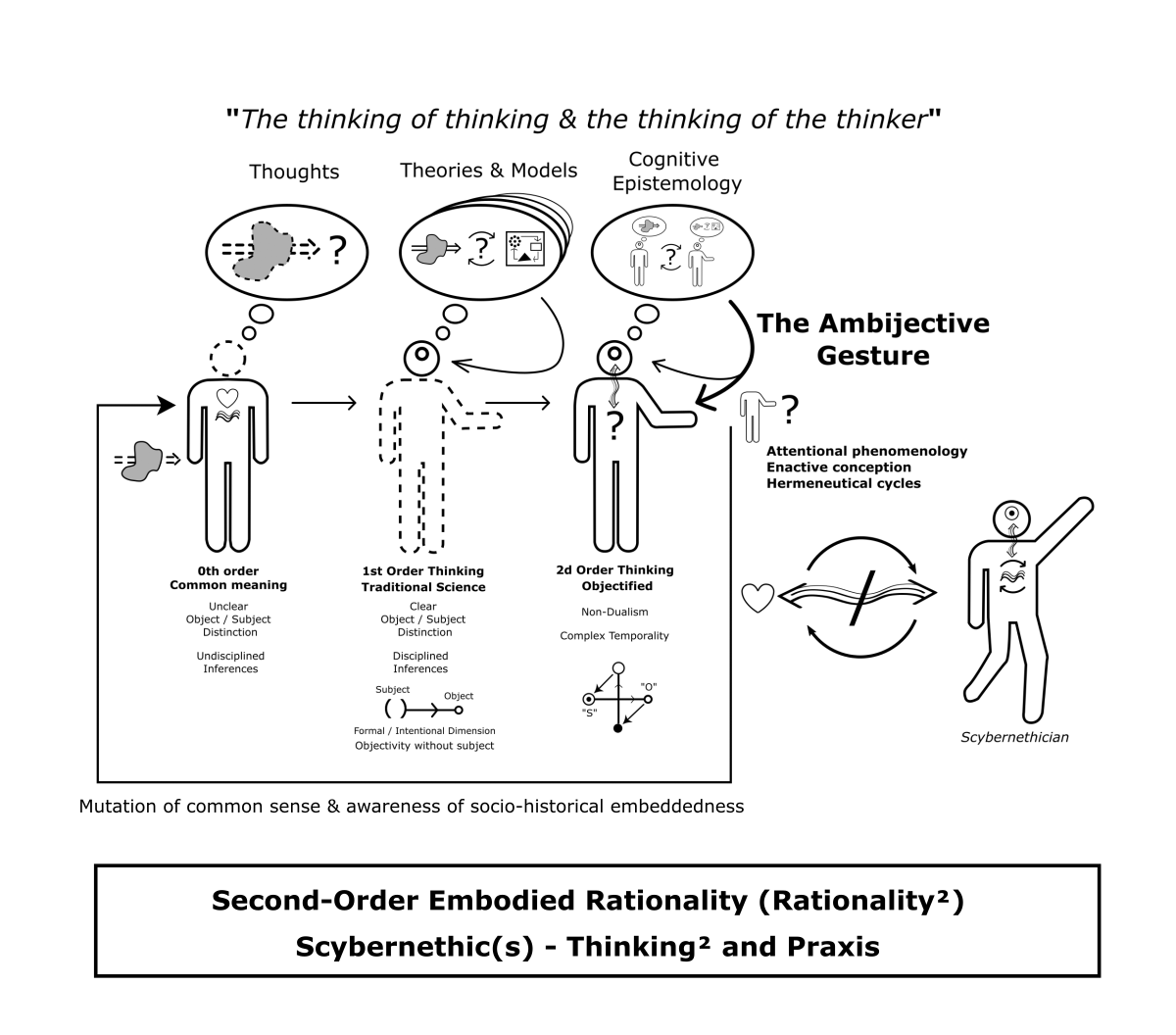
4.1 From First-Order Methods to Second-Order Rationality
The heart of Scybernethics is a lived second-order rationality—a stance that takes as its domain not only objects but the processes and conditions of their emergence. Following Heinz von Foerster’s dictum, “An observer is its own ultimate object,” Scybernethics positions the agent as both observer and participant in their own process of invention (von Foerster, cited in Scott, 1996).
Second-order rationality is not infinite regress, but a new regime of self-relatedness: one that flexibly alternates between first- and third-person, subjective and objective, gesture and description.
4.2 The Role of Computer Simulation and Hypomnemata
A key medium for this rationality has been the use of computer simulation—not as a reduction of cognition to algorithm, but as a hermeneutical tool. Simulation becomes both laboratory and metaphor: a way of revealing implicit patterns, testing dialogical hypotheses, and exploring emergent invariants under shifting parameters.
Similarly, hypomnemata (memorial self-writing technics, Stiegler/Foucault/Plato) provide a persistent interface for tracking, reconfiguring, and documenting the evolution of self and theory. In this sense, Scybernethics is not only an intellectual output but an existential “externalization” and feedback system, much like the technical objects Simondon describes as mediators of individuation.
Chapter 5: Participatory Sense-Making and Lived Bio-Logic
5.1 Beyond the Observer: Toward Creative Cognition
If “all knowing is being” (Varela, Maturana, Thompson), then the practice of Scybernethics compels a radical immersion: the creation of knowledge is inseparable from the lived modification of the agent, and creativity is not a mysterious act but a process of participatory sense-making.
Participatory sense-making, as articulated by De Jaegher & Di Paolo, is instantiated within Scybernethics not only socially but intra-psychically, as the dialogical play of multiple voices, logics, modalities. This is not schizophrenic dissociation but an opportunity for richer, more nuanced individuation.
5.2 Lived Bio-Logic as Existential Achievement
Scybernethics refigures logic as “bio-logic”—a coupling of formal precision and lived, embodied logic of action and sense. The ambition is neither to collapse into affect nor retreat into abstraction, but to maintain the sensitive dynamic equilibrium of living systems—homeostatic, but never at rest.
Conclusion: Scybernethics as the Invention of Myself—Ongoing Projects
In light of Simondon’s ontology, the invention of Scybernethics is not merely the production of a new conceptual scheme, but the ongoing individuation of myself as agent, theorist, and actor within, and through, that scheme. The process, endlessly recursive and open-ended, sustains itself through new compatibilities—extrinsic and intrinsic—reconfiguring milieu and self, and bringing forth new worlds of possibility.
Scybernethics, as invention, is thus both a genealogy and a teleology—a retrospective mapping of becoming, a forward-propelling engagement with the open circuit of possibility and praxis.
Looking Forward
As with all invention worthy of the name, the process continues: every new situation, tension, or encounter propels the individuation further. Scybernethics is not finished, nor ever definitive; rather, it is a living experiment in self and collective invention, mediated by technological, cognitive, and existential hermeneutics for a time and world that demands richly responsible forms of sense-making.
References
- Bitbol, M. (2006). L’aveuglement de la science.
- De Jaegher, H., & Di Paolo, E. (2007). Participatory sense-making. Phenomenology and the Cognitive Sciences, 6, 485–507.
- Simondon, G. (2022). Individuation in Light of Notions of Form and Information (transl. T. Adkins). University of Minnesota Press.
- Varela, F., Thompson, E., & Rosch, E. (1993). The Embodied Mind: Cognitive Science and Human Experience. MIT Press.
- Varela, F. (1976). Organism: A Meshwork of Selfless Selves. In New Scientists.
- von Foerster, H. (2003). Understanding Understanding: Essays on Cybernetics and Cognition. Springer.
- Scott, B. (1996). Second-order cybernetics: An historical introduction. Kybernetes, 25(6/7), 8–20.
- Stiegler, B. (2010). For a New Critique of Political Economy. Polity.
- Additional reference documents, diagrams, and resources at https://scybernethics.org and https://github.com/cog-data/Scybernethics
This article is a lived and documented reflection, open to further dialogical expansion and technological/practice-based iteration.
°°°°~x§x-<@>